

Please note that some of the links on this site are affiliate links and we earn from qualifying purchases. This does not cost you anything extra, but it helps us keep the lights on. Thank you for your support!
Cantilever scope mounts are one of the most common ways to mount magnified optics on AR-15 and AR-10 rifles, especially when running LPVOs or MPVOs. While shooters often focus on the optic itself, the mount plays a major role in maintaining zero, securing the scope, and ultimately tying the rifle and optic together as one.
The problem is there are a ton of options, from cheap mounts that simply get the job done to premium mounts designed around weight, modularity, quick detach capability, or precision. The best scope mount for one rifle isn’t necessarily the best for another.
That’s why I tested these mounts across different rifles and broke the results into categories based on where each one actually performed best. This guide covers the best cantilever scope mounts I’ve tested for AR-15s and AR-10s, including options for LPVOs, precision setups, lightweight builds, QD, modularity, and overall value.
Quick picks based on hands-on testing. Click any mount to jump to the details.
-
Jump to details →Best Overall MountScalarworks FUSE
-
Jump to details →Best Lightweight MountAmerican Rifle Company AIR Brace
-
Jump to details →Best Precision MountArea 419 Cantilever Mount
-
Jump to details →Best QD MountDLOC Precision Cantilever
-
Jump to details →Best General Purpose MountZero Gravity Summit
-
Jump to details →Best Modular MountBadger Ordnance Condition One
-
Jump to details →Best Value MountVortex Pro Extended Mount
Testing note: each mount was installed to spec, run for 700+ rounds before re-checking fasteners, then removed to inspect for scope tube marks or marring.
Table of Contents
How We Tested
Cantilever mounts are one of the most overlooked components on an AR-15 or AR-10. A quality optic and accurate rifle won’t matter much if the mount can’t maintain zero, hold the scope securely, or withstand recoil over time.
For this guide, each cantilever scope mount was installed according to the manufacturer’s recommended torque specifications using a calibrated torque driver and paired with optics ranging from LPVOs to mid or long range precision scopes.
Once mounted, the rifles were fired extensively, with each mount seeing minimum of 700 rounds.
During testing, I evaluated:
- Ease of installation
- Machining quality and finish
- Ring alignment and clamping force
- Zero retention and repeatability
- Resistance to loosening under recoil
- Overall stability and scope retention
- Mount-to-rail lockup and contact
- Scope tube protection
Minimum Requirements
Beyond the individual testing categories, there are a few things I consider non-negotiable before a scope mount earns a spot in this list:
- No loss of zero during testing
- No loosening under recoil
- No stripped or damaged hardware when torqued to manufacturer specifications
- No movement of the scope inside the rings once secured
- No permanent marring or damage to the scope tube
- No movement or failure at the rail interface
After testing, each optic was removed and inspected for tube marring, movement, uneven ring pressure, or any other signs of damage.
Over the years, I’ve encountered mounts that stripped screws before reaching torque specification, loosened during live fire, failed to maintain zero, or left permanent marks on expensive optics.
If a mount fails any of these basic requirements, it doesn’t make this list regardless of its price, weight, features, or brand name.
Meet the Expert
Danny Lux is the founder of The Tactical Den and has spent years testing and evaluating rifles, optics, mounts, triggers, and accessories across AR-15s, precision rifles, and hunting rifles.
His reviews are based on hands on experience, live fire testing, long term use, and direct comparison with competing products. Rather than relying solely on manufacturer specifications, Danny focuses on how gear performs in real world applications, from range sessions and rifle builds to hunting and field use.
Best Cantilever Scope Mounts
Best Overall Mount: Scalarworks FUSE

Scalarworks FUSE
The Scalarworks FUSE ended up being the most versatile mount I tested. It’s lightweight, extremely well machined, and feels incredibly compact and rigid installed.
One feature that really stood out during installation is Scalarworks LevelDrive system, which helps simplify leveling the optic. However, it does have a limitation, it only works properly if the bottom of the scope is actually true to the reticle, so confirming level with (my favorite) the plumb bob method is still important.

The ring design is also well thought out. The caps feature three screws per side with wider rings, which helps distribute clamping pressure more evenly across the scope tube compared to traditional two screw designs. This helps prevent optic movement and reduces the chance of marring the tube.
I ran the mount on a GP rifle build with a Trijicon Credo 1-10 paired with a 12 o’clock Acro P2 using Scalarworks KICK accessory line. The system offers solid modularity, allowing for offset or 12 o’clock back up dots, and even integrated levels.

After putting roughly 700 rounds through the setup before checking torque, nothing shifted and held zero the entire time. Then the rings were removed and the scope tube looked exactly the same as it did before installation.
Because it balances weight, strength, compactness and modularity, the FUSE earns its spot as the Editor’s Choice and the “Jack of All Trades” mount or Overall mount.
Pros
- ✓ Excellent balance of weight, strength and modularity
- ✓ Compact design without sacrificing rigidity
- ✓ KICK system supports 12-o’clock and offset red dots
- ✓ Wide rings
Cons
- × LevelDrive should still be verified against the reticle
- × Often out of stock
Best Lightweight Mount: American Rifle Company AIR Brace
American Rifle Company AIR Brace
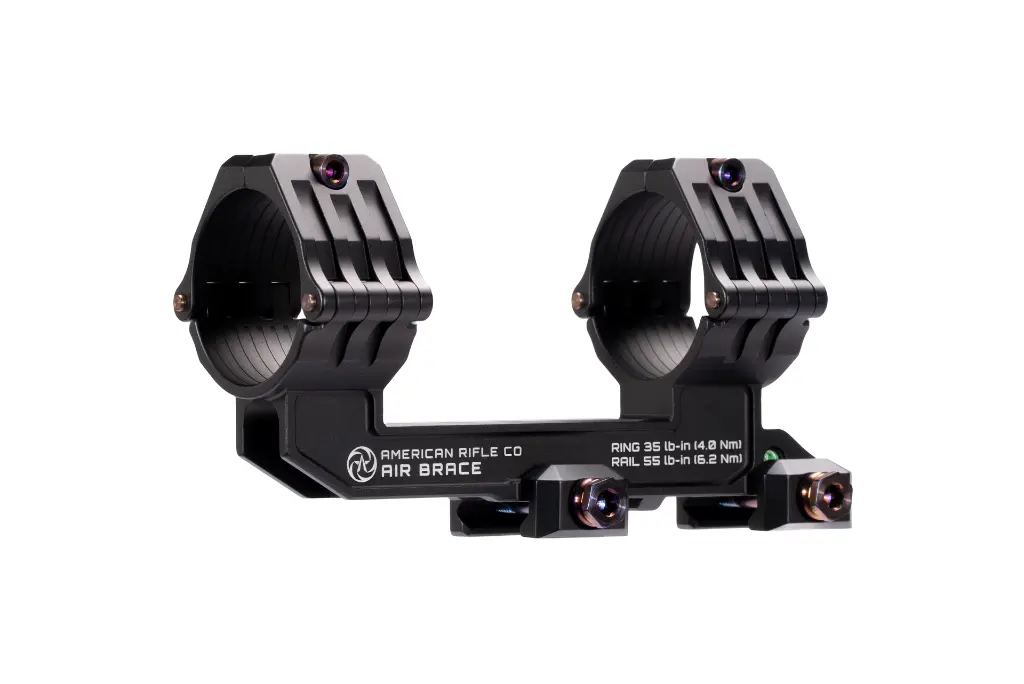
The American Rifle Company AIR Brace is one of the lightest cantilever mounts I’m aware of on the market, coming in at under 4 ounces. But despite the extremely low weight, it doesn’t sacrifice rigidity or performance.
One feature you don’t see very often, but is common with ARC mounts, is the hinged ring design. this keeps the clamps symmetrical while tightening, which eliminates scope roll when torquing and makes installation noticeably smoother. It also helps prevent residual torsion from being introduced into the scope tube. Relief cuts at the 12 o’clock position further reduce the chance of marring the tube.

The mount’s tubular cantilever structure maximizes stiffness while keeping the design lightweight and compact. It almost reminds me of a miniature I beam, giving the mount excellent rigidity with virtually no flex once installed.
Another nice feature is the built in level at the rear of the mount, allowing you to confirm the rifle is level without breaking cheek weld.

After roughly 700 rounds of testing, the mount stayed completely secure, zero stayed locked and the scope tube showed no marks or damage from the rings.
The only drawback is the lack of modular accessories… it has zero. But for lightweight precision or RECCE style builds, the AIR Brace is an excellent option.
Pros
- ✓ Ultra Lightweight
- ✓ Hinged rings make scope leveling noticeably easier
- ✓ Built-in level
- ✓ Compact design works especially well on lightweight builds
Cons
- × Zero modular accessory support
- × Only in available in 1.5″ Height
Best Precision Mount: Area419 Cantilevered Tactical One-Piece Mount

Area 419 Cantilever Mount
If you haven’t heard of Area 419, they’ve built a strong reputation for high quality precision rifle accessories, and their Cantilevered Tactical One Piece Mount definitely reflects that.
Each mount is machined from 7075 aluminum, with the base and ring caps final bored together as a matched pair. The rings have a wide footprint with a center dowel, and the raw aluminum inside gives them an extremely secure grip on the scope tube.

Performance wise, this thing is rock solid. After over 1,000 rounds of testing now, nothing loosened or shifted, and there was absolutely zero noticeable flex or movement.
When I removed the scope, you could see where the raw aluminum rings contacted the tube, but the marks wiped away pretty effortlessly with a microfiber cloth and left no damage behind or signs or the tube moving.
You also get a ton of modularity with 12-o’clock plates, offset mounts, Picatinny rails, diving boards, and integrated levels. Most can be added without removing the ring caps or disturbing your leveled optic which is a huge WIN.

At around 8–9 ounces without accessories, it’s definitely a little overbuilt and can be a bit bulky depending on your setup. But for a precision rifle, that’s a tradeoff I’m willing to make.
The Area 419 is rigid, extremely secure, and built with precision in mind.
Pros
- ✓ Extremely rigid, rock-solid construction
- ✓ Matched base and ring caps for precise alignment
- ✓ Excellent scope tube grip and retention
- ✓ Strong modular accessory ecosystem
- ✓ Most accessories can be added without disturbing the leveled optic
Cons
- × Heaviest Mount on list at around 8–9 oz before accessories
- × Feels bulky with smaller optics
- × Weight can add up quickly once accessories are installed
Best QD Mount: DLOC Precision Cantilever

DLOC Precision Cantilever
Quick detach mounts are one of those things shooters either love or hate. I’ve always been a little skeptical about repeatability with QD mounts, and most of the time when a scope goes on one of my builds, it stays there. But return to zero performance is still something I want to know I can trust.
DLOC may not be one of the biggest names in the mount world, but the quality speaks for itself. The mount is designed, machined, and assembled in Texas, with their patented Deros Lock On Control (DLOC) system being what really sets it apart. In fact, if you’ve ever heard of Trijicon’s Q-LOC line, DLOC is actually the powerhouse behind that exact design.

Instead of external QD levers, the DLOC uses spring loaded knobs and an auto adjusting lockup system. Underneath, there are three recoil lugs per rail interface, and the DLOC has more mount to rail surface contact than any other mount I tested. That combination gives it a ton of rail engagement and helps it return to the same position each time.
Now I couldn’t find a published weight for the mount anywhere, so I weighed it myself. The DLOC Precision Cantilever Mount came in at an impressive 7.3 oz.

Mounting is incredibly simple. Back the knobs out, press them in, place the mount on the rail, and snug them down by hand, no tools or torque adjustments. Crazy, I know. I didn’t believe it either until I actually tried it.
What really got me was how secure this thing feels. Even before tightening the knobs, there’s practically zero movement, and once they’re snugged down, the lockup is extremely solid.
Return to zero was just as impressive. Now roughly 800 rounds of testing, I removed and reinstalled the mount every 100 rounds for the first 500, and it returned almost perfectly to zero every time.

Nothing loosened, the scope never moved, and the rings stayed properly torqued. After testing, I removed the optic and found no marks or damage to the scope tube.
For a QD cantilever mount, the DLOC is easily one of the most impressive I’ve tested. I still can’t get over how secure this thing feels, even with the knobs backed off.
Pros
- ✓ Excellent return-to-zero performance
- ✓ Extremely solid lockup with practically zero movement
- ✓ More mount-to-rail surface contact than any mount I tested
- ✓ Three recoil lugs per rail interface
- ✓ Tool-free installation and removal
Cons
- × Very limited modular accessory support
Best General Purpose Mount: Zero Gravity Summit

Zero Gravity Summit
The Zero Gravity Summit uses a three-piece hinged ring design similar to the ARC AIR Brace earlier in this list. Installation is extremely smooth, with the rings closing evenly around the scope tube and making it easy to keep the optic level without fighting scope roll when torquing.

The base has a nice wide footprint for stability, but material is removed anywhere it isn’t needed. Even with that larger footprint, the Summit weighs just over 5.5 ounces, giving it a great balance between strength and weight.
I also like the flush rail clamp screws. They keep everything clean and streamlined, and once torqued down, this thing locks up extremely solid with no noticeable flex or movement.
I have over 850 rounds of .308 through the Summit now, and nothing moved. The rings held their torque, the optic stayed secure, and after removing the scope at around 500 rounds there were no marks or damage to the tube or any indication of the scope moving.

Unlike the Air Brace you actually get a little bit of modularity out of the mount, with the ability to swap the hinged ring section for a 12-o’clock red dot mount supporting multiple footprints.
The Summit is lightweight, rigid, easy to install, and pretty much everything I’d want from a general purpose scope mount.
Pros
- ✓ Lightweight
- ✓ Three-piece hinged rings make leveling easier
- ✓ Excellent scope tube contact with no marring
- ✓ Wide, rigid mounting footprint
- ✓ Optional 12-o’clock red dot mounting
Cons
- × Can be hard to find in stock, so you may need to grab one when it’s available
- × Limited Modularity
Best Modular Mount: Badger Ordnance Condition One

Badger Ordnance Condition One Modular Mount
The Badger Ordnance Condition One is easily one of the most configurable scope mounts I’ve used and on the market. The mount itself is extremely solid, but it’s the accessory ecosystem that really sets the C.O.M.M. apart.
I’ve been running the C.O.M.M. on my 18″ PWS 6mm ARC build, also on my DD M4, and the mount itself has been rock solid. The machining is excellent, it clamps securely to the rail and scope tube, and I haven’t had any issues with loosening or movement through a combined round count of over 1000 rounds.

What I really like is that you aren’t locked into one configuration. You can add a piggyback or offset red dot, a level, diving board, angle cosine indicator, NightCap elevation turret illuminator, and even a data card holder as your setup evolves.
One thing to note is you do have to swap the original ring cap if you want to run something like a 12-o’clock red dot or diving board. But once the accessory cap is installed, you can swap the top mounted accessories without removing the cap or disturbing your scope again.
The other downside is that all that modularity can get expensive pretty quickly. Once you start adding ring caps, plates, and other accessories, you’re well beyond the price of the base mount.
But if modularity is the priority, or you want a mount that you can grow into as your build evolves and you progress as a shooter, that’s exactly why you’re buying it. The Badger C.O.M.M. is the most configurable mount I’ve personally used.
Pros
- ✓ Massive accessory ecosystem
- ✓ Can grow with your build
- ✓ Easy to change top-mounted accessories
- ✓ Rock-solid lockup and excellent machining
Cons
- × Accessories get expensive quickly
- × 12-o’clock setups require swapping the original ring cap
- × Weight can add up with accessories
Best Value Mount: Vortex Pro Extended Mount

Vortex Pro Extended Mount
With an MSRP of $229.99 but regularly found for around $150 at retailers like OpticsPlanet or Brownells, the Vortex Pro is one of the most well rounded mounts I’ve tested for the money. It’s not the lightest or most compact option, but it doesn’t feel unnecessarily bulky either, and the overall construction and lockup feel extremely solid.

One thing that stood out during installation was the amount of surface contact with the mount to rail interface. Once torqued to spec, the optic felt completely secure, and after nearly 1,000 rounds of testing now, there wasnt any loose screws or movement.
Just as importantly, when I removed the optic after testing, there were no visible marks or marring on the scope tube. That’s something I like to pay close attention to, especially after seeing cheaper mounts leave permanent marks on expensive optics or not having a strong enough hold and seeing marks from the scope moving in the mount.
Here’s a quick look at installing and leveling the Vortex Pro Extended Mount.
The Vortex Pro doesn’t necessarily win in any one extreme category. But for around $150, you get a solid, secure, well rounded cantilever mount without breaking the bank.
Pros
- ✓ Excellent value for around $150
- ✓ Solid, secure lockup on the rail
- ✓ Excellent scope tube contact and retention
- ✓ No loosening after nearly 1,000 rounds
- ✓ Left no marks or marring on the scope tube
Cons
- × Limited Variations and Options available
- × Lacks the modular accessory ecosystem
Quick Comparison: Best Cantilever Scope Mounts
| Mount | Category | Weight | Height | Tube | MSRP |
|---|---|---|---|---|---|
| Scalarworks FUSE | Editor’s Choice | 5.3 oz | 1.57/1.70″ | 30/34/35/36mm | $319 |
| ARC AIR Brace | Best Lightweight | 3.9 oz | 1.5″ | 30/34/36mm | $349 |
| Area 419 | Best Precision | 8-9 oz | 1.34/1.54″ | 30/34/35/36mm | $350 |
| DLOC Precision | Best QD | 7.3 oz | 1.53/1.63/2.05″ | 30/34mm | $299 |
| Zero Gravity Summit | Best General Purpose | 5.6 oz | 1.54/1.7/1.93″ | 30/34/35mm | $349 |
| Badger Condition One | Best Modular | 6.6 oz | 1.54/1.7/1.93″ | 30/34/35mm | $325 |
| Vortex Pro Extended Mount | Best Value | 7 oz | 1.44″ | 1″,30/34mm | $229.99 |
What Is a Cantilever Scope Mount & When Should You Use One?
A cantilever scope mount is a one piece mount commonly used on AR-15s and AR-10s to position the scope farther forward on the rifle. This gives you the room needed to get proper eye relief with an LPVO or other magnified optic while keeping the entire mount secured to the upper receiver.
The other big advantage is avoiding bridging the receiver and handguard. Even with a quality free float handguard, I don’t want part of my optic mounted across two separate components that can flex or shift independently.
If the upper receiver and handguard aren’t perfectly aligned, you can also introduce binding as the mount or rings are tightened. Now you could be chasing a zero or dealing with an optic that’s under unnecessary stress or potentially moving.
There are exceptions, like MK12 style rifles with a continuous top rail. In that case, you can use traditional scope rings because both rings are mounting to one solid rail rather than bridging two separate mounting surfaces.
Choosing the Right Scope Mount Height: 1.54 vs 1.70 vs 1.93
Scope mount height on an AR-15 is measured from the top of the Picatinny rail to the centerline of the optic. Because AR style rifles use an inline stock design, the optic needs to sit high enough for your eye to naturally align with it while maintaining a comfortable cheek weld.
For LPVOs and other magnified optics, 1.54, 1.70, and 1.93 inches are three of the most common mount heights. The right choice mostly comes down to your shooting position, natural head position, and the equipment mounted to your rifle.
1.54″ The Traditional Cheek Weld
1.54″ is my personal preference for most AR-15 and AR-10 builds. It gives me a solid, repeatable cheek weld and a natural sight picture without unnecessarily raising the optic.
Also keeping the optic closer to the bore of the barrel reduces height over bore, meaning there is less mechanical offset between your point of aim and the bore at close distances. The difference between common mount heights isn’t huge, but it’s still an advantage of keeping the optic lower when you don’t need the extra height.
I also run piggyback red dots pretty often. Starting with a 1.54″ mount keeps the secondary optic at a more manageable height instead of stacking a red dot on top of an already tall setup.
1.70″ Lower 1/3 Height
A 1.70″ scope mount is commonly known as the lower 1/3 height. Lower 1/3 means that if you’re running backup iron sights, they’ll sit roughly in the lower third of your sight picture rather than directly in the center.
It also gives you a slightly more upright head position while still maintaining decent contact with the stock, making it a great middle ground between 1.54″ and 1.93″.
For example, I run a 1.70″ Badger COMM on my DD M4. It keeps my backup irons lower in the sight picture and out of the way while still giving me a comfortable, repeatable head position.
1.93″ Heads-Up & Equipment Clearance
A 1.93″ scope mount is commonly used for two main reasons: additional clearance over top rail mounted equipment and a more upright, heads up shooting position. If you’re running a laser, light, or other device along the top of the handguard, the additional optic height can reduce how much of that equipment obstructs your sight picture. Some shooters also simply find the more upright head position more comfortable.
Personally, I don’t run 1.93″ mounts on my scoped carbines anymore. They just weren’t for me, and I found I needed a cheek riser to maintain the consistent cheek weld I want behind a magnified optic.
In my opinion, 1.93″ height makes more sense with a red dot, where eye relief isn’t a factor and your head position can be a little more forgiving. If 1.93″ works for you and your setup, though, use what works.
Which Scope Mount Height Should You Choose?
| Height | Choose It If… | My Take |
|---|---|---|
| 1.54″ | You want a traditional cheek weld and don’t have a specific reason to go taller. | My default for most scoped ARs. |
| 1.70″ | You run backup irons or have used 1.54″ and want a little more height. | Great middle ground and common lower 1/3 height. |
| 1.93″ | You need clearance over top-mounted equipment or prefer a heads-up shooting position. | Better fit for specialized setups; not my preference for scoped carbines. |
0 MOA vs 20 MOA Scope Mounts
Another option you’ll see when choosing a scope mount is 0 MOA vs 20 MOA cant. This refers to the angle built into the mount, not the height of the optic.
A 0 MOA mount holds the scope parallel to the rifle’s rail and is what I’d recommend for most AR-15s, LPVOs, and general-purpose rifles. For typical shooting distances, there’s usually no reason to add extra cant when the scope already has plenty of elevation adjustment available.
A 20 MOA mount angles the scope slightly downward toward the muzzle, giving you more usable elevation adjustment for long range precision shooting. This makes more sense on precision or long range setups where you may otherwise start running out of available elevation in the scope.
Which Cant Should You Choose?
| Cant | Choose It If… | Best For |
|---|---|---|
| 0 MOA | You don’t need additional elevation adjustment for long-range shooting. | LPVOs, general-purpose ARs, and most 5.56 setups. |
| 20 MOA | You want more usable elevation available in your scope for long-range shooting. | Precision ARs, MPVOs, higher-magnification optics, and long-range setups. |
Quick Pick: For most LPVO-equipped AR-15s and general-purpose rifles, stick with 0 MOA. Choose 20 MOA when you’re building around long-range shooting and need additional elevation adjustment from your optic.
August 2026 Update
I’m back with some updates. I removed the Warne budget category and replaced it with Best Value because this is a best of list, not a cheapest mount list. The Warne fits much better in my upcoming Best Scope Mounts Under $100 guide. I also added the Badger Ordnance Condition One as Best Modular Mount after getting enough time behind the C1 and its accessory ecosystem to confidently give it that spot. Round counts have also been updated, and every other mount currently recommended still stands in its category.
I’ve also had some readers ask about the ADM QD mount. I tested it well before putting this guide together, and while it’s a solid mount, the DLOC performed better in the areas I care about most: lockup, rail engagement, and repeatability, so it remains my Best QD Mount. I’ve also recently started testing the BOBRO QD cantilever mount, and first impressions have been very good. It still needs more rounds and repeated removal before I can fairly put it head-to-head with the DLOC, but that comparison is coming.
Final Thoughts
Scope mounts can be one of the most overlooked parts of a rifle setup, and a bad mount can quickly turn into frustrating zeroing issues, loose hardware, or chasing down a shift that shouldn’t be happening in the first place.
After extensive hands-on testing, these are the best scope mounts I’ve tested for AR-15s and AR-10s running LPVOs, MPVOs, and precision setups. Every mount on this list proved it could stay tight, hold zero, securely retain the optic, and protect the scope tube through extended use.
There isn’t one best scope mount for every rifle. Some prioritize weight, others modularity, precision, QD repeatability, or overall value, so the right choice really comes down to your rifle and what you need the setup to do.
FAQs
What is the best cantilever scope mount?
The Scalarworks FUSE is my best overall cantilever scope mount. It’s lightweight, extremely well machined, easy to install, and provides a secure mounting system without adding unnecessary bulk.
What is the best LPVO mount for an AR-15?
For most AR-15 LPVO setups, I prefer a quality one piece cantilever mount. Scalarworks FUSE is my overall pick, while the Badger Ordnance Condition One is my choice if modularity is the priority. But each of these mounts above shine in its own category.
What height scope mount should I use?
1.54″ is my preference on an AR for a natural cheek weld and lower height over bore. A 1.70″ mount is a good middle ground, while 1.93″ works well when you need additional clearance or prefer a more heads up shooting position.
Should I use a 30mm or 34mm scope mount?
Match the mount to your scope’s main tube diameter. A 30mm scope requires a 30mm mount, while a 34mm scope requires a 34mm mount.
Can you mount a red dot to an LPVO mount?
Yes and No. Many modular LPVO mounts support piggyback or offset red dots. The Badger Ordnance Condition One is one of my favorites for this because of its large accessory ecosystem. But some mounts like the ARC Air Brace doesn’t support piggyback or offset red dots.
Are cantilever mounts better than scope rings on an AR-15?
For most AR-15s and AR-10s, cantilever mount are preferred and recommended because it provides proper forward offset while keeping the mount secured to the upper receiver. Traditional rings make more sense when the rifle has a continuous top rail providing one solid mounting surface like on a MK12 with a PRI rail and SPR Straight Top Rail.
Should you bridge a scope mount between the receiver and handguard?
Generally, no. Keep the scope mount secured to the upper receiver because the handguard can flex or move independently of the receiver.
Should I use a QD or fixed scope mount?
Choose QD if you regularly remove or swap your optic. If the optic is staying on the rifle, a quality fixed mount is usually the simpler choice.
Do I need a 0 MOA or 20 MOA scope mount?
For most LPVOs and general purpose AR-15s, 0 MOA is the better choice. A 20 MOA mount is more useful for precision or long range rifles where additional elevation adjustment is needed.
How far forward should an LPVO be mounted on an AR-15?
Mount the LPVO far enough forward to achieve a full sight picture and comfortable eye relief with your normal cheek weld and stock position. A cantilever mount allows you to do this while keeping the mounting base on the upper receiver.
Related AR-15 Guides
Looking for more ways to upgrade your rifle? Be sure to check out some of my other AR-15 guides below:
- Best AR-15 Triggers – From duty triggers to precision setups, these are my favorite trigger upgrades for improving accuracy, consistency, and overall shooting performance.
- Best AR-15 Stocks – From lightweight hunting builds to precision rifles and duty-ready carbines, these are my top stock recommendations for improving comfort, stability, and overall rifle handling.
- Best Duty AR-15 Triggers – A hands-on guide to the duty triggers I’d trust when reliability, consistency, and confidence under stress matter most.
More AR-15 guides, build breakdowns, and hands-on reviews are on the way, including uppers, barrels, charging handles, optics, and accessories I’ve personally tested. Be sure to subscribe to the newsletter so you don’t miss future reviews, buying guides, and rifle projects.


Leave a Reply